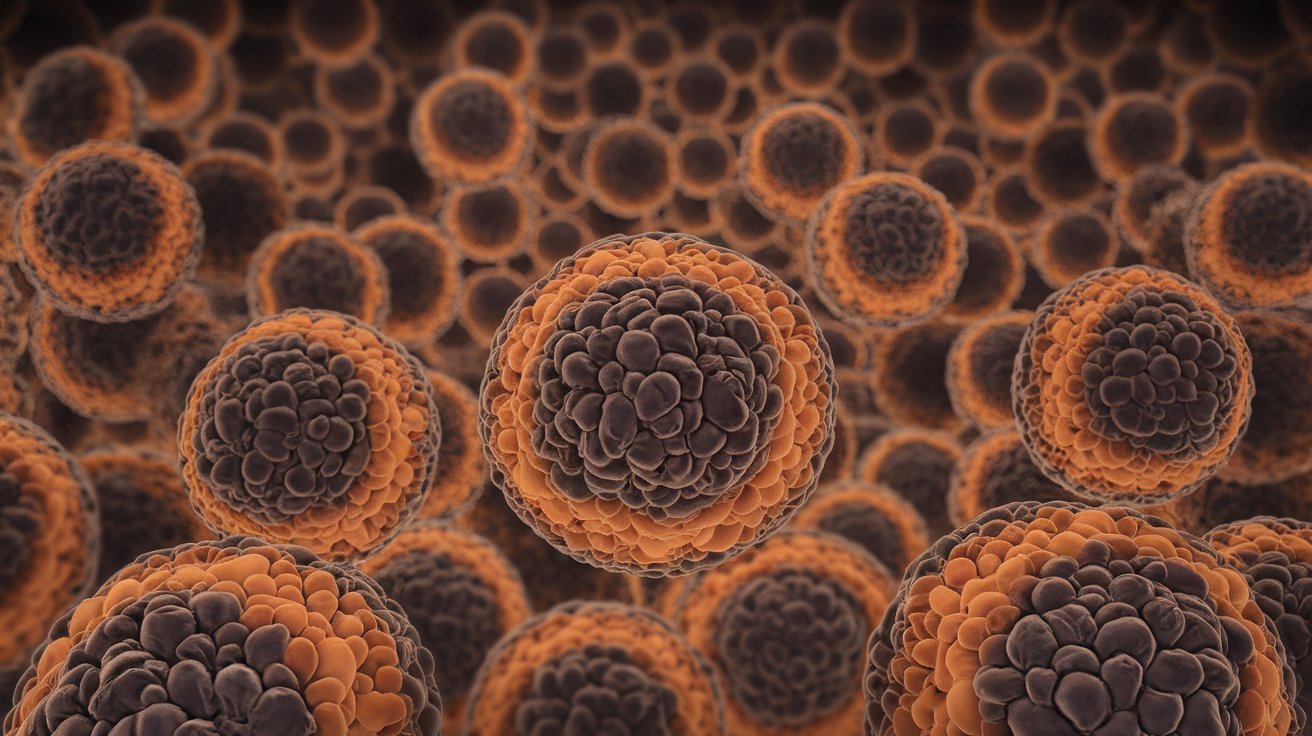
Look at your hand. Now, look at the world around you. The solidity of your desk, the fluidity of water, the vibrant life of a leaf, the vast, empty space of the night sky. It all seems so diverse, so beautifully complex. Yet, at the very core of this breathtaking variety lies a profound and universal secret. Everything you see, touch, and are, from the air you breathe to the screen you’re reading on, is built from atoms. And at the heart of every atom, holding the ultimate key to its identity, lies a tiny, furious, and unimaginably powerful world: the atomic nucleus.
For too long, the nucleus has been that quiet, unassuming character in the story of matter, overshadowed by the flashy dance of electrons. But today, we are going to pull back the curtain. We are going to venture into this infinitesimal core to understand not just what it is, but why it is the true architect of our reality. This is the story of the most concentrated form of stuff in the universe, and it is a story of immense forces, cosmic alchemy, and the very origin of the elements that make our lives possible.
What Exactly Is Hiding in There?
Let us start with the basics. Imagine an atom is a vast, empty cathedral. If the nucleus were a marble placed at the very center of this cathedral, the electrons would be like dust motes whizzing around in the distant rafters. This analogy, first popularized by the great physicist Ernest Rutherford, is not just poetic; it is startlingly accurate. The nucleus occupies only a trillionth of the atom’s volume, yet it commands over 99.9% of its mass. It is the anchor, the sun to the electrons’ planets, the dense, heavy core around which the ethereal cloud of electrons orbits.
So, what is this dense core made of? We have known for nearly a century that it is a tightly bound society of two types of particles: protons and neutrons, collectively known as nucleons.
-
Protons carry a positive electrical charge. This number is the atom’s atomic number, its unique fingerprint. It defines what element the atom is. One proton? You have hydrogen. Six protons? That is carbon. Seventy-nine protons? You are looking at gold. The proton is the element’s unwavering identity card.
-
Neutrons are the neutral partners, carrying no charge and a mass almost identical to the proton. They are the social glue of the nucleus. While the number of protons is fixed for an element, the number of neutrons can vary. Atoms of the same element with different numbers of neutrons are called isotopes. Think of them as different versions of the same fundamental character; carbon-12 (6 protons, 6 neutrons) is stable and common, while carbon-14 (6 protons, 8 neutrons) is slightly heavier and radioactive, a trait we use for radiocarbon dating.
This simple picture, however, belies a deep and puzzling mystery. If you have ever played with magnets, you know that like charges repel each other. The force of this repulsion is incredibly powerful at close range. Now, imagine cramming several dozen positively charged protons into a space a million billion times smaller than a grain of sand. The electromagnetic force pushing them apart should be astronomical, enough to blow the nucleus apart in a fraction of a nanosecond. And yet, it does not. It holds together with an iron grip. This brings us to the first of the nucleus’s great secrets: a force so potent it can overcome the will of electromagnetism itself.
Read Also: The Vidbinge Era: How Our Love Affair with Streaming Reshaped Everything
The Strong Force: The Universe’s Ultimate Glue
The reason atomic nuclei do not simply fly apart is because of the strongest force in the known universe, aptly named the strong nuclear force. This is the true protagonist of our story, the invisible hand that holds reality together.
The strong force is fundamentally different from gravity or electromagnetism. While those forces diminish with distance, the strong force is a short-range specialist. It operates only over distances comparable to the size of a proton or neutron. At these tiny scales, it is about 100 times stronger than the electromagnetic force. However, step just a little outside that range, and it drops to virtually zero. This is why you do not feel a “nuclear pull” towards the person next to you; the force is locked inside the nucleus, a master of its own microscopic domain.
This force does not just act between protons and neutrons; it is the force that holds the quarks together inside each proton and neutron. But on the nuclear scale, its residual effect is what binds the nucleons into a stable cluster. It is a relentless, powerful attraction that, for stable nuclei, perfectly balances the fierce repulsion of the protons’ positive charges. This delicate dance between the electromagnetic force trying to tear things apart and the strong force holding them together is the central drama of the atomic nucleus. The outcome of this struggle determines whether an atom is stable or radioactive.
When the Balance Fails: The Story of Radioactivity
What happens when the nucleus’s internal tug-of-war goes wrong? When the number of protons and neutrons is out of balance, and the strong force can no longer quite keep up with the electromagnetic repulsion? We get radioactivity, the nucleus’s way of trying to achieve stability.
A nucleus with too many or too few neutrons relative to its protons is like a wobbly top. It is unstable and will eventually “decay,” transforming itself into a more stable configuration by spitting out a piece of itself. This is not a sign of weakness; it is a natural process of correction. There are several ways this happens:
-
Alpha Decay: A heavy, unstable nucleus, like that of uranium or radium, ejects a cluster of two protons and two neutrons. This is essentially a helium-4 nucleus. It is a relatively slow, heavy particle, but it is a sign of a large nucleus shedding weight to become more stable.
-
Beta Decay: This is a more subtle process. Here, a neutron, feeling a bit unstable itself, transforms into a proton. In doing so, it emits an electron (called a beta particle in this context) and an almost massless particle called an antineutrino. This changes the identity of the atom, moving it one step up on the periodic table.
-
Gamma Decay: Sometimes, a nucleus is left in an “excited” state after another event, like a child still buzzing with energy after a fun day. To settle down, it releases pure energy in the form of a high-energy photon called a gamma ray. This does not change the atom’s identity, just its energy level.
This seemingly chaotic process of radioactive decay is not random destruction. It is a fundamental, rule-based mechanism that powers everything from nuclear reactors to medical treatments for cancer. It is also our most powerful tool for peering back in time.
The Cosmic Forge: Where Nuclei Are Born
To truly appreciate the nucleus, we must ask the most profound question of all: where did they come from? The answer is a cosmic saga of creation that spans the lifetime of the universe.
In the very beginning, after the Big Bang, the universe was a searing hot soup of fundamental particles. As it expanded and cooled, within the first few minutes, protons and neutrons began to fuse, forming the first nuclei. This period, known as Big Bang Nucleosynthesis, produced the universe’s primordial hydrogen and helium, along with a tiny trace of lithium. And then, it stopped. The universe was too cool and diffuse for anything else to form.
For millions of years, the universe was a simple place, filled with these light elements. The story could have ended there, a cosmos of hydrogen and helium forever. But then, gravity went to work. It pulled together vast clouds of this primordial gas, compressing and heating them until they ignited into the first stars. The cores of these stars became furnaces, recreating the intense heat and pressure of the early universe.
Inside stars, a process called nuclear fusion takes over. Under immense gravity, hydrogen nuclei (protons) are forced together, overcoming their mutual repulsion, to form helium. This process releases the energy that makes stars shine. As a star ages and runs out of hydrogen, it begins to fuse helium into carbon, and then carbon into heavier elements like oxygen and neon, all the way up to iron.
Here, we hit a wall. Fusing elements up to iron releases energy, which powers the star. But to create any element heavier than iron, you need to add energy. A regular star cannot do this. So, how did the gold in your jewelry or the uranium in a power plant come to be?
The answer is in the most violent and creative events in the universe: supernova explosions and the collisions of neutron stars. In the cataclysmic fury of a dying massive star, or the incredible collision of two ultra-dense stellar corpses, a flood of neutrons is available. Nuclei rapidly capture these neutrons and then undergo beta decay, transforming neutrons into protons, thus climbing the periodic table to create all the heavy elements we know. Every atom of oxygen in the water you drink, every atom of calcium in your bones, and every atom of iron in your blood was forged in the heart of a long-dead star and scattered across the cosmos by its spectacular death. We are, quite literally, stardust, and the nucleus is the immutable record of that ancient stellar ancestry.
Harnessing the Nucleus: Power and Medicine
Our understanding of the nucleus has allowed us to tap into its profound power, for both creation and destruction. The principles of nuclear fission, where a heavy nucleus like uranium-235 is split into smaller fragments, form the basis of nuclear power and, tragically, nuclear weapons. This process releases the binding energy that was holding the large nucleus together, a quantity of energy millions of times greater than any chemical reaction like burning coal.
But the nucleus’s role in technology is not limited to massive power plants. It has quietly revolutionized medicine. Radioactive isotopes are used as tracers in medical imaging, allowing doctors to see the flow of blood or the activity of specific organs. Perhaps the most powerful application is in radiation therapy, where carefully controlled beams of radiation, often gamma rays or high-energy electrons, are used to target and destroy cancer cells by shredding their DNA. The same nuclear processes that can cause harm are, with precision and care, being used to save lives.
The Quantum Realm: The Final Frontier Inside the Nucleus
Even with all we know, the atomic nucleus remains a frontier of physics. We cannot truly understand its behavior without venturing into the strange world of quantum mechanics. The protons and neutrons inside a nucleus are not static marbles in a bag. They exist in specific, quantized energy states, much like the electrons in their orbits.
The nucleus itself can have different energy levels, or “shells.” This shell model helps explain why certain numbers of protons and neutrons lead to exceptional stability. These “magic numbers” correspond to filled nuclear shells, creating nuclei that are perfectly spherical and remarkably robust, like the noble gases of the nuclear world.
Furthermore, the line between a proton and a neutron can blur. The entire nucleus can be thought of as a collective, a liquid drop of nuclear matter that can vibrate and rotate. In some isotopes, the nucleus can become dramatically deformed, stretching into a football shape. Studying these exotic nuclei, often created for only fractions of a second in powerful particle accelerators, helps us test the fundamental laws of physics and understand the forces that govern all matter.
The Silent Architect of Our World
The atomic nucleus is the ultimate paradox: impossibly small, yet unfathomably dense; hidden from view, yet responsible for all we see. It is a world governed by the strongest forces in nature, a place where the elements of the universe are defined, and a relic of the most violent cosmic events.
It is the reason the periodic table has structure. It is the source of the sun’s life-giving light. It is the power behind both devastating weapons and life-saving medical treatments. It is the historical record of our cosmic origins, a tiny time capsule from the first moments of the universe and the fiery hearts of stars.